
California tattoo age requirement is 18 years old, with no exceptions for parental consent, making it illegal to tattoo a minor under any circumstances. Tattoo licensing in California operates under the California Safe Body Art Act, which requires body art practitioners to complete bloodborne pathogen training and register with their county health department rather than obtain a state-issued license.
Why California’s Tattoo Age and Licensing Rules Matter
California minors are legally barred from receiving tattoos, a stricter standard than many states that allow tattoos for minors with parental consent. According to the California Health and Safety Code Section 119302, it is a misdemeanor to tattoo anyone under 18, even with a signed parental consent form. This differs sharply from piercing and tattoo regulations for body piercing, where minors can receive certain piercings with parental consent. Understanding California tattoo laws protects both consumers and business owners from legal liability, health risks, and criminal charges.
Key Characteristics of California’s Tattoo Age Restriction
- Absolute age minimum: The legal tattoo age in California is 18, with zero exceptions—unlike the legal tattoo age by state that varies elsewhere, where 18 states permit minors to get tattoos with parental consent.
- No parental consent loophole: A California minor tattoo consent form does not exist because state law prohibits tattooing anyone under 18, regardless of guardian approval.
- Criminal liability: Violating this law can result in misdemeanor charges against the tattoo artist, not the minor or parent.
- Piercing distinction: California piercing age laws permit ear piercing for minors with parental consent, but this exception does not extend to tattoos.
- Statewide uniformity: The California legislature enforces this rule consistently across all 58 counties, leaving no room for local exceptions.
How California’s Tattoo Licensing System Works
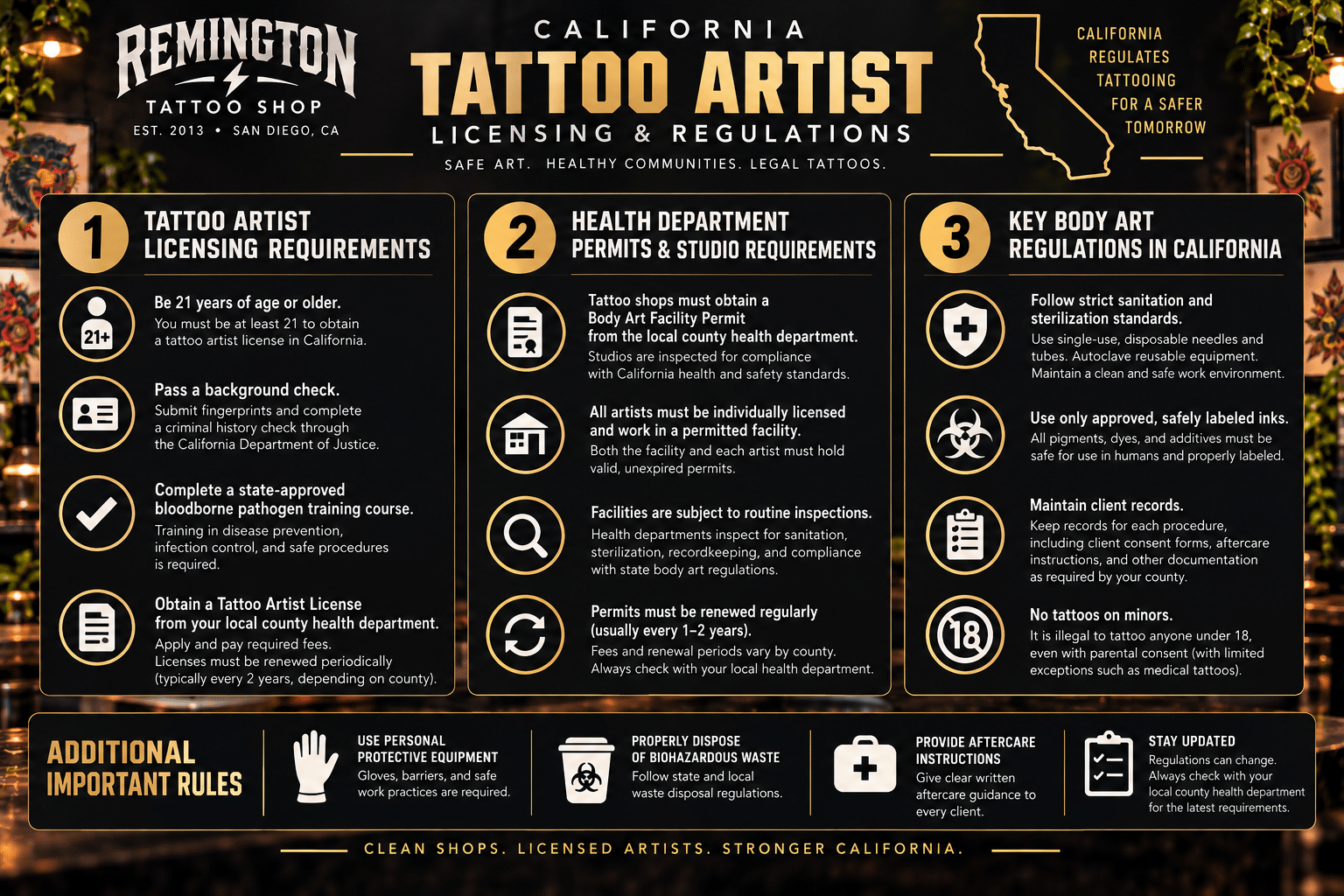
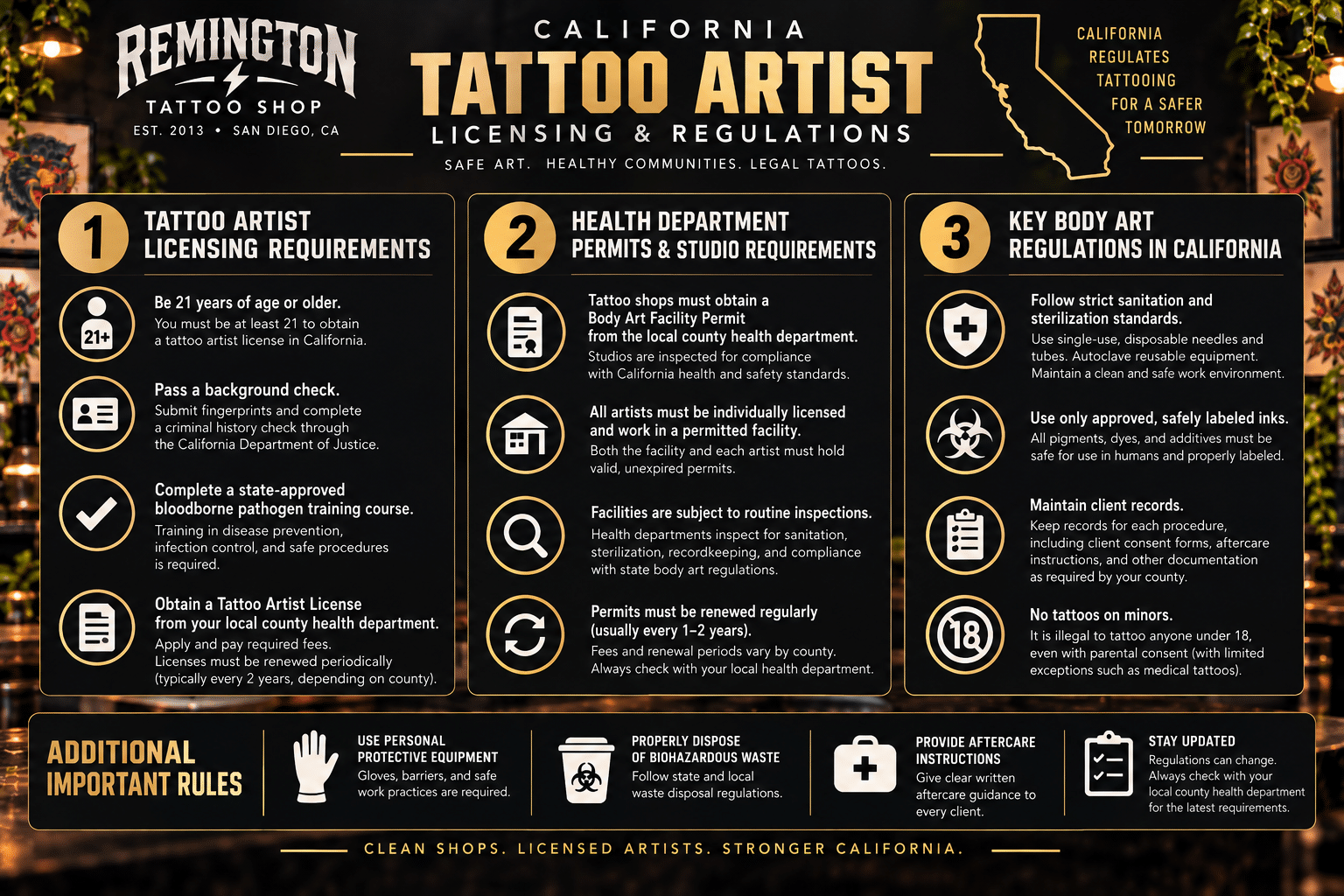
California does not issue a traditional “tattoo license” through a centralized state licensing board tattoo California system. Instead, the state relies on a registration-based model administered locally. Here is how the process works:
Step 1: Body Art Practitioner Registration
Every artist must complete body art practitioner registration through their local county health department. This is not the same as a cosmetology license; California cosmetology board tattoo oversight does not apply to tattoo artists, only to hair, nail, and skin care professionals.
Step 2: Bloodborne Pathogen Training
Before registering, artists must complete bloodborne pathogen training and provide a certificate proving completion. This tattoo artist certification California requirement ensures practitioners understand infection control, disease transmission, and emergency response protocols.
Step 3: Tattoo Studio Permit Application
Studio owners must file a tattoo studio permit application with their county health department, which functions as body art facility registration. This process typically includes:
- Submitting facility floor plans showing sanitation stations
- Providing autoclave certification documents for sterilization equipment
- Paying a body art registration fee (varies by county, typically $200–$500 annually)
- Passing an initial inspection by a state health inspector or local public health officer
Step 4: Ongoing Compliance and Inspections
Licensed tattoo shops undergo periodic tattoo shop health inspection California visits to verify sterilization equipment requirements are met. Inspectors check autoclave logs, single-use needle disposal, and CalOSHA regulations compliance for workplace safety.
Step 5: Tattoo Apprenticeship Program (Optional Path)
California tattoo apprenticeship requirements are not codified by the state but are typically set by individual studios. Most tattoo apprentice license California pathways require 1,000–2,000 hours of supervised work before an apprentice can register independently as a body art practitioner.
Common Misconceptions About California Tattoo Laws
Myth: A 16-year-old can get a tattoo in California with parental consent.
Reality: No age exception exists. Unlike some states, California law makes it illegal to tattoo a minor under any circumstances, including with signed parental consent.
Myth: Tattoo artists need a cosmetology license to legally tattoo in California.
Reality: Tattoo artists register through county health departments under the California Safe Body Art Act, not through the California Business and Professions Code’s cosmetology licensing division.
Myth: Any adult can legally open a tattoo shop without inspections.
Reality: Every tattoo studio permit application requires a facility inspection by a state health inspector before opening, and ongoing tattoo shop inspection requirements continue throughout operation.
Myth: Tattoo removal has no age restrictions.
Reality: Tattoo removal age laws in California generally align with tattoo application laws, requiring practitioners to verify age and, in some cases, obtain physician oversight for laser procedures.
Licensing vs. Registration: Understanding the Difference
| Aspect | Traditional State License | California’s Registration Model |
|---|---|---|
| Issuing Authority | State licensing board | County health department |
| Renewal Frequency | Varies (often 2 years) | Annual, per tattoo artist license renewal rules |
| Training Requirement | Formal state exam | Bloodborne pathogen training certificate |
| Oversight Body | Centralized state board | California Department of Public Health guidelines, enforced locally |
| Facility Requirement | Not always required | Body art facility permit mandatory |
Practical Applications: What This Means for You
For Consumers
Before booking an appointment, verify how to verify a tattoo artist’s license in California by checking county health department registries. Confirm the shop displays a current body art facility permit and ask about tattoo liability insurance coverage, which protects clients in case of infection or allergic reaction.
For Aspiring Tattoo Artists
If you’re wondering what is required to become a licensed tattoo artist in California, the steps are straightforward: complete a tattoo apprenticeship program, finish bloodborne pathogen training, and register with your county health department. This process differs from other states that require formal licensing exams.
For Studio Owners
Steps to open a tattoo shop in California legally include securing a body art facility permit, meeting sterilization equipment requirements, passing a California health department tattoo shop inspection checklist review, and maintaining CalOSHA regulations compliance for employee safety. Zoning laws also apply—tattoo shop zoning laws California vary by city, so confirm permitted business locations with local planning departments before signing a lease.
For Parents
Do minors need parental consent for tattoos in California? No—parental consent is legally irrelevant because the practice is prohibited outright for anyone under 18. This makes California’s stance among the strictest in the nation regarding tattoo consent laws California.
Frequently Asked Questions
How old do you have to be to get a tattoo in California without parental consent?
You must be 18 years old. There is no lower age with or without parental consent.
Is it legal to tattoo a minor in California under any circumstances?
No. California Health and Safety Code Section 119302 makes it illegal to tattoo anyone under 18, with no exceptions.
What are the health requirements for tattoo shops in California?
Shops must maintain autoclave certification, follow sterilization equipment requirements, complete regular health inspections, and comply with CalOSHA regulations for bloodborne pathogen exposure control.
As of 2024, California tattoo laws remain among the most protective in the United States, combining a strict minor consent laws framework with a decentralized but rigorous body art practitioner registration and body art facility registration system. Staying informed on California body art safety act requirements ensures both compliance and public safety for artists, studio owners, and clients alike.